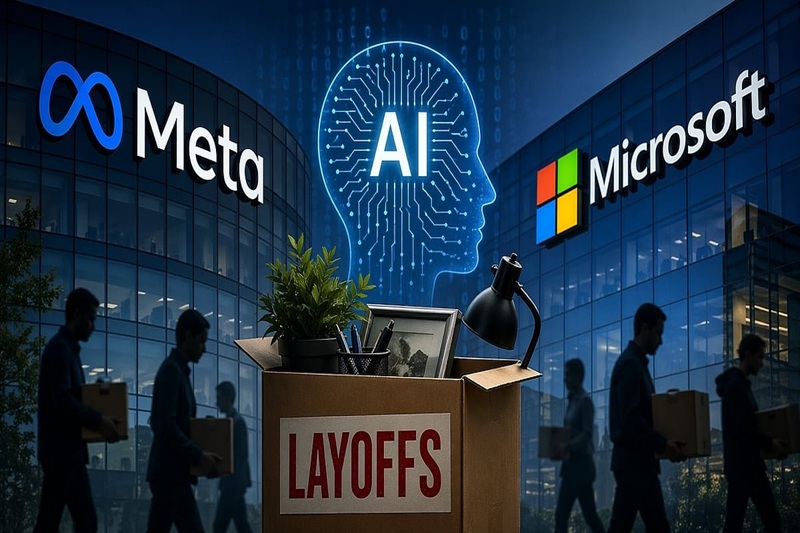
Meta and Microsoft Cut 16,000 Jobs as AI Reshapes the Tech Workforce Is Your Role Safe A routine morning that changed everything
It began like any normal workday. Meetings were lined up, emails were flowing, and teams were moving through their usual tasks. Then came the message no one expected. For thousands of employees at Meta and Microsoft, inbox notifications brought sudden and life changing news. Layoffs and buyout offers reached nearly 16,000 workers, pushing many into uncertainty. What stands out is not just the scale of these job cuts. It is the reason behind them. Artificial intelligence is now directly shaping how companies decide who they need and who they do not.
What exactly happened?
Meta has cut around 8,000 jobs, close to 10 percent of its workforce. It is also leaving many positions unfilled, which signals a long term shift rather than a temporary move. Microsoft is offering buyouts to about 8,750 employees in the United States. While this approach seems less abrupt, the goal is similar. The company is reducing workforce costs while investing heavily in AI infrastructure and products.Together, these decisions represent one of the largest AI driven workforce changes in recent years.
Why 2026 feels like a turning point
Layoffs in the tech industry are not new, especially after the hiring boom during the pandemic. But 2026 seems to be a milestone. AI is no longer a mere support tool. It has become integral to the strategy of businesses. The question of how many employees are necessary in a business is raised against the backdrop of technological advancement that enables many business functions to be performed by technology. Roles in customer support, testing, and operations are either being automated or are becoming simpler. This is forcing companies to rethink how work is structured. In simple terms, AI is changing the basic idea of employment.
From engineering to HR: no department untouched
Automation was once seen as a threat mainly to technical jobs. Now its impact is spreading across departments. Artificial intelligence is capable of supporting such processes as resume sorting, report creation, process automation, and data analysis. Tasks which earlier required teams of employees can be handled by fewer people with artificial intelligence technology. This compels the human resources, financial, and operational departments to rethink their approach. The majority of such tasks involve repetitive activities, thus simplifying automation processes. Companies often call this efficiency. For employees, it means adapting quickly or facing the risk of being replaced..
The effect on human life
Numbers aside, there are people faced with rapid changes to their daily lives.For those employees who are experiencing layoffs, there is a great deal of uncertainty that goes along with it. Future plans may need to be revised, goals altered, and security no longer guaranteed. Anxiety related to AI’s ability to steal jobs is increasing, especially amongst the white collar sector. As they lose jobs, employees are also discovering opportunities that were unavailable before. There are emerging opportunities in fields such as engineering and cyber security. But making the transition from established careers to these emerging career paths poses unique challenges. It is this difference in the loss of old jobs and creation of new ones that causes trouble for many.
The consequences on the economy
These effects reach far beyond just the technological sphere, as companies may start restructuring their businesses with the help of AI, leading to layoffs of employees. For business owners and investors, this process offers efficiency and increased profitability. Meanwhile, governments become concerned about the security of employees’ jobs. There is also a new divide forming based on whether workers can adapt to using the technology.
Is this the future of work?
The changes at Meta and Microsoft reflect a larger trend. AI is not just supporting decisions anymore. It is influencing them. The idea of a stable job is changing. Skills are becoming more important than job titles. Being able to learn and adapt is now essential.
AI Is Redefining Work Not Just Reducing Jobs
The job cuts at Meta and Microsoft are not just about saving money. They reflect a profound change in how work itself is understood. AI has effected radical transformations in firms, allowing organizations to downsize, and at the same time requiring the workforce to be highly specialized. Although departments such as HR are unlikely to disappear altogether, they have changed beyond recognition. What matters now is not just staying employed but being relevant.
FAQs
1. What makes Meta and Microsoft reduce their workforce in 2026?
Because they want to cut costs and invest in AI.
2. Are there any links between AI and this reduction?
AI-based automation is essential in the process.
3. Are there any risks associated with HR careers?
Career jobs requiring repetitive task execution may be at risk.
4. What are the jobs available in the current scenario?
There will be new jobs in AI jobs such as data scientist and machine learning specialist
5. How can employees prepare for the coming change?
Employees must learn about AI and data skills and focus on judgement jobs.