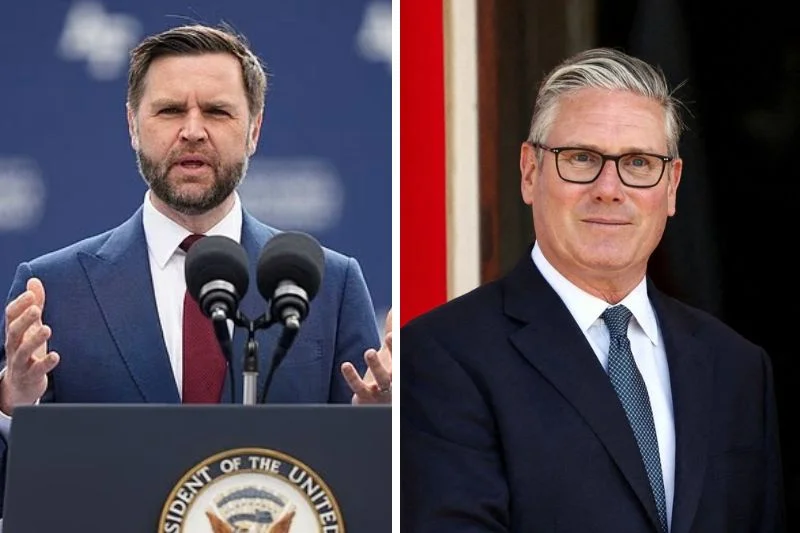
Why Are the US and UK Leadership Feuding on X Today? The Viral J.D. Vance & Keir Starmer Clash Explained
A political disagreement that had been quietly developing for months suddenly came to light this week. US Vice President J.D. Vance and UK Prime Minister Keir Starmer openly clashed online over free speech, migration, and their differing views on the future of Western democratic values. What started as criticism during speeches and interviews has grown into a major social media fight, mainly happening on X. There, clips, reaction posts, memes, and political commentary have taken over trending topics throughout the day. The public nature of this dispute has drawn attention on both sides of the Atlantic because it involves more than just online words. Underneath the viral exchanges lies a significant disagreement about censorship, border policy, digital regulation, and the increasingly fragile nature of the US-UK “special relationship.”
How the Vance-Starmer Clash Escalated Online
The latest round of tension grew after Vance criticized European governments, including Britain, for what he called increasing hostility toward free expression. In several widely shared statements, he accused Western leaders of silencing dissenting voices while overlooking public frustration about migration and crime. Those comments quickly spread on X, where conservative commentators in the US and Europe amplified his message. They framed it as a warning about Britain’s political direction under Starmer’s government. British officials responded swiftly. Starmer openly rejected the notion that the UK undermined free speech. He insisted that Britain has a strong democratic tradition of protecting open debate while enforcing laws against extremism and online abuse. Members of his government also pushed back against what they described as outside interference in British political matters. That exchange alone might not have gained global attention, but the timing made it a significant culture-war issue. Clips of Vance criticizing “mass migration failures,” along with his earlier comments about European governments being out of touch with ordinary citizens, resurfaced almost immediately. This created a viral cycle that kept the feud trending for hours.
Why Free Speech Has Become the Center of the Argument
At the heart of the dispute is a philosophical divide over how governments should regulate speech and digital platforms. Vance and his allies, including former President Donald Trump, argue that many European speech laws go too far. They believe the rules targeting harmful online content could turn democratic governments into gatekeepers of acceptable opinion. Starmer’s government has a different view. British officials argue that modern online spaces need protections against hate speech, misinformation, harassment, and extremist material. From London’s perspective, regulation is not censorship; it is a necessary response to how digital platforms influence public life. The disagreement has intensified as Britain has recently moved toward stricter online safety measures. This includes pressure on major tech companies to remove harmful or manipulated content more thoroughly. This situation inevitably pulled X into the center of the political storm.
Migration and Crime Added Fuel to the Fire
The clash grew stronger after Vance connected Britain’s migration policies to rising public anger following a high-profile violent crime case. Several UK politicians condemned his comments. They accused him of taking advantage of tragedy to gain political points. However, his remarks found strong support among conservative groups online. These groups were already frustrated with immigration levels across Europe and North America. For Starmer, it became politically necessary to respond firmly. Allowing a senior American leader to publicly question British policy without a clear response risked making his government look weak at home. For Vance, the confrontation fits well with the populist message that defines his political identity in the US. He expresses skepticism toward elite institutions, emphasizes border control, and issues repeated warnings about cultural decline in the West.
More Than Social Media Drama
Despite the memes and viral posts, analysts say the argument matters because it reflects real political strain between two traditionally close allies. The United States and United Kingdom continue to work closely on issues like NATO, Ukraine, and global security. However, public disputes over democracy, speech laws, and technology regulation complicate diplomatic relations behind the scenes. Both leaders are also considering domestic political factors. Vance’s confrontational tone appeals to conservative voters who feel Western governments have become disconnected from public concerns about identity, borders, and speech rights. Starmer, on the other hand, faces pressure to demonstrate that Britain will not be lectured by Washington, especially on issues related to national sovereignty and British law. This combination makes compromise harder. Every comment quickly becomes viral content.
Recommended Reads You Shouldn’t Miss
Explore Why Nintendo Raised Prices?
Check the latest reasons behind Nintendo Switch 2 price hikes worldwide and what it means for gamers.
Discover One Piece 1182 Spoilers?
Explore the expected release date, major twists, and key manga spoilers fans are discussing.
Check BTS Mexico Tour Frenzy?
Discover how BTS received a massive welcome as global ARMY fans gathered in Mexico.
Explore Jessica Jones Marvel Return?
Check how Daredevil: Born Again Season 2 is reshaping Marvel’s street-level universe.
Discover Cinco de Mayo Food Trends?
Explore how tacos and regional tequilas are transforming Cinco de Mayo celebrations in 2026.
What This Means for the Future of US-UK Political Relations
The tension may ease publicly if both governments see that the political costs are too high compared to the attention they get online. However, many observers think the feud shows something bigger than just a temporary trend on social media. Discussions about platform regulation, migration policy, and freedom of expression are becoming key political issues in Western democracies. As long as these topics stay heated online, conflicts like this will likely keep happening. Currently, X is both the stage and the symbol of a larger ideological struggle between two political views competing for power throughout the Western world.
FAQs
Why are J.D. Vance and Keir Starmer arguing publicly?
The dispute centers on free speech, migration, online regulation and accusations that Britain is moving away from traditional democratic values.
Is this damaging US-UK relations?
While the countries remain close allies, the public rhetoric has highlighted growing disagreements over speech laws, tech regulation and migration policy.
What role does X play in the conflict?
X is both the platform where the argument spread and a key subject of the debate because of disagreements over online content moderation and regulation.
Could the situation calm down soon?
Possibly, but ongoing disagreements over migration and speech regulation mean similar clashes could continue in the future.