

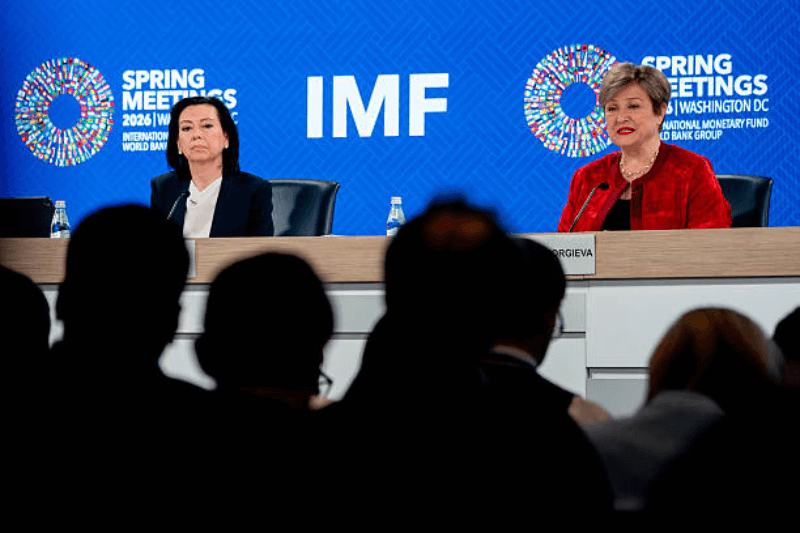
IMF Recession Warning: Rising Market Volatility Signals Global Economic Slowdown
The IMF recession warning signals rising global Market volatility is no longer an occasional shock. It is becoming a defining feature of today’s global economy. Stocks slipped again, echoing past reactions to similar warnings, with the Dow dropping more than 300 points in comparable moments. Behind the turbulence lies a growing concern. Recession risks are quietly building, and investors are starting to take notice.
As per the latest warning, although an economic recession may be on its way but not necessarily imminent, the world economy is now headed towards a more delicate stage. The economy faces uneven growth, inflation, and rising geopolitical tensions.
Investment Directions at Present Time
In such a scenario, there will surely be some changes in investing patterns. There could be a renewed interest in bonds if interest rates come down. But, as discussed above, the inflation factor is always going to keep the actual benefits low. This is why investors are focusing on safe bets such as utility stocks, which have steady demand. There is also increasing demand for precious metals such as gold. The broader takeaway is clear. Diversification is no longer optional. It is essential.
Everyday Impact Households Feel the Pressure
For everyday households, these economic signals are already turning into real life changes.
Fuel and food prices remain unpredictable, forcing people to manage their budgets more carefully. Large purchases are being delayed as uncertainty grows. This is not panic, but it is caution. Governments face a difficult balance. Supporting vulnerable groups is necessary, but broad subsidies can increase inflation. Policymakers are trying to avoid repeating past mistakes.
Worldwide disproportionate effects
The impacts won’t be evenly distributed.Countries that rely on tourism could see their income
fall, while countries that rely on imports could see their costs rise. The disparities of these effects will further worsen existing inequities especially in economically weak countries.
Economists warn that social tensions could increase if economic stress continues to grow.
IMF Outlook Cautious but Not Alarming
The IMF’s tone remains measured, but not reassuring.Risks are tilted to the downside, meaning there is greater potential for conditions to worsen in the near term. Diplomatic efforts could ease some pressure, but uncertainty remains high.
Investment Strategy Defending Position
The priority for investors now is to move from offense to defense. Limiting investment in cyclical stocks may help minimize risks. The dividend-paying companies that operate in essential industries will be more stable in an uncertain environment. Exchange-traded funds based on commodities and inflation-protected bonds are also considered to shield against continuing shocks.Cash becomes increasingly important as well. In a volatile market, liquidity becomes an advantage.
Long-Term Perspective It’s Not All Bad
While there are worries about the near-term future, the long-term prospect isn’t all bad.
Technology and artificial intelligence sectors are still promising, assuming there are no heightened tensions between nations. In the long run, these sectors may prove beneficial to investors.
What to Look For Next
Oil prices and developments related to strategic global shipping lanes, particularly the Strait of Hormuz, will determine what comes next. For now, this is not a moment for panic, but it is a
moment for preparation.A recession is not guaranteed, but the possibility is becoming harder to ignore. In an environment defined by uncertainty, staying informed and adaptable may be the most valuable strategy.
FAQs
Why did the IMF cut growth projections?
Escalating Middle East war disrupts oil via Strait of Hormuz closure, triggering higher commodities, inflation, and tight finance.
Is a global recession inevitable?
Not locked in baseline is 3.1%, but adverse scenarios drop to 2-2.5% if conflict drags.
What does this mean for stocks?
Volatility; move into defensive plays such as gold and utilities because of overvalued stock markets and energy crises.
What about inflation, will it spike?
Yes, to 4.4% baseline, higher in worse cases, reversing disinflation.
Best investment tip right now?
Diversify, hold cash, eye inflation hedges, watch energy prices closely.


