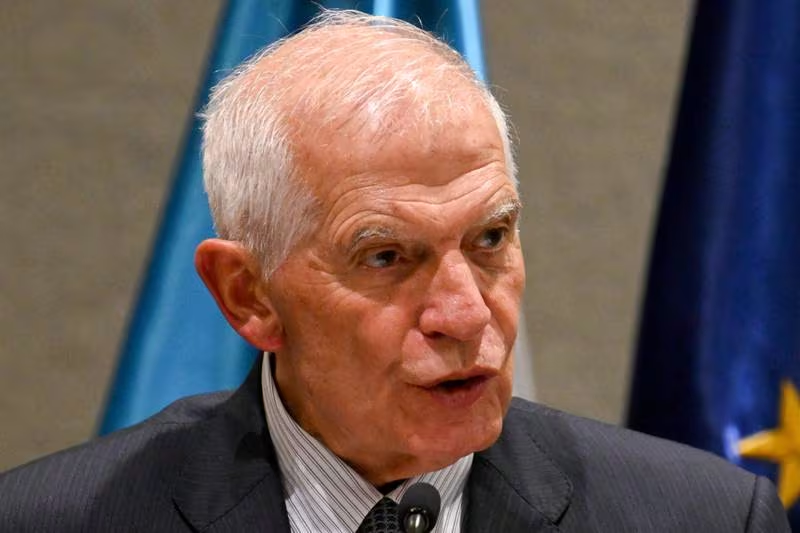
EU Foreign Policy Chief Vows to Push for Two-State Solution in Middle East
In the heart of Brussels, foreign ministers from the European Union convened to discuss the pressing issue of the Israeli-Palestinian conflict. The EU’s foreign policy chief, Josep Borrell, made a bold statement, expressing unwavering determination to pursue a two-state solution in the Middle East. This commitment comes at a crucial moment, as top Israeli and Palestinian diplomats engage in talks that could shape the future of the region.
Building a Two-State Solution
Josep Borrell wasted no time in addressing the core objective of the gathering – to build a lasting two-state solution. In response to Israeli Prime Minister Benjamin Netanyahu’s firm stance against a Palestinian state, Borrell urged open dialogue. He questioned the viability of alternative solutions proposed by Israel, especially in light of the ongoing conflict in the Gaza Strip.
Consequences of the Conflict
The meeting, attended by Israeli Foreign Minister Israel Katz and Palestinian counterpart Riyad al-Maliki, revolves around a 12-point discussion paper. This paper delves into the aftermath of Hamas’s attack on Israel in October and Israel’s subsequent offensive in Gaza. It emphasizes the critical need for a peace process to achieve the two-state solution, suggesting that any alternative governance in Gaza could be seen as an extension of occupation, denying Palestinian rights.
Peace Talks Amidst Bloodshed
The document, presented by the EU, calls for the initiation of peace talks despite the ongoing bloodshed. The EU recognizes the urgency of addressing the conflict head-on and proposes that peace talks should commence immediately, irrespective of the current violence. This stance underscores the EU’s commitment to seeking diplomatic resolutions even in challenging circumstances.
Netanyahu’s Opposition and International Response
Notably, Prime Minister Netanyahu has been a longstanding opponent of the establishment of a Palestinian state. His recent rejection of any moves toward a two-state solution, coupled with sharp rebukes against US and EU foreign policy, has stirred international concern. EU foreign ministers, arriving at the Brussels summit, collectively denounced Netanyahu’s position.
The Irish foreign minister, Micheál Martin, deemed Netanyahu’s rejection of a two-state solution unacceptable. France’s new foreign and European affairs minister, Stéphane Séjourné, expressed worry over Netanyahu’s remarks. The German foreign minister, Annalena Baerbock, pointed out that those opposing a two-state solution had not presented viable alternatives.
Katz’s Mission and Jordan’s Perspective
Israeli Foreign Minister Israel Katz, addressing reporters in Brussels, emphasized his mission to “bring back our hostages” and sought continued EU support for Israel’s offensive against Hamas. Katz highlighted the challenging conditions under which Israeli soldiers were fighting to achieve these aims.
On the other side, Jordanian Foreign Minister Ayman Safadi stressed that the war must end, emphasizing the importance of a two-state solution. Safadi, reflecting on over 30 years of peace talks, asserted that a moment of truth had arrived. He questioned whether the international community would allow a radical racist agenda to dictate the future or unite for a path toward peace.
EU’s Proposed Approach
The EU’s discussion paper, while not providing explicit solutions, recommends that future peace conferences should outline “consequences” for both sides based on their acceptance or rejection of proposed plans. The document remains silent on the specifics of these consequences but hints at potential leverage points the EU holds.
Conclusion: A Call for Diplomacy
In conclusion, the EU’s firm commitment to pursuing a two-state solution in the Middle East stands out as a beacon of hope amidst regional turmoil. The international community, represented by EU foreign ministers, collectively emphasizes the urgency of peace talks and condemns any opposition that lacks viable alternatives. As the diplomatic discussions unfold, the EU positions itself as a key player advocating for a comprehensive and lasting solution to the Israeli-Palestinian conflict.