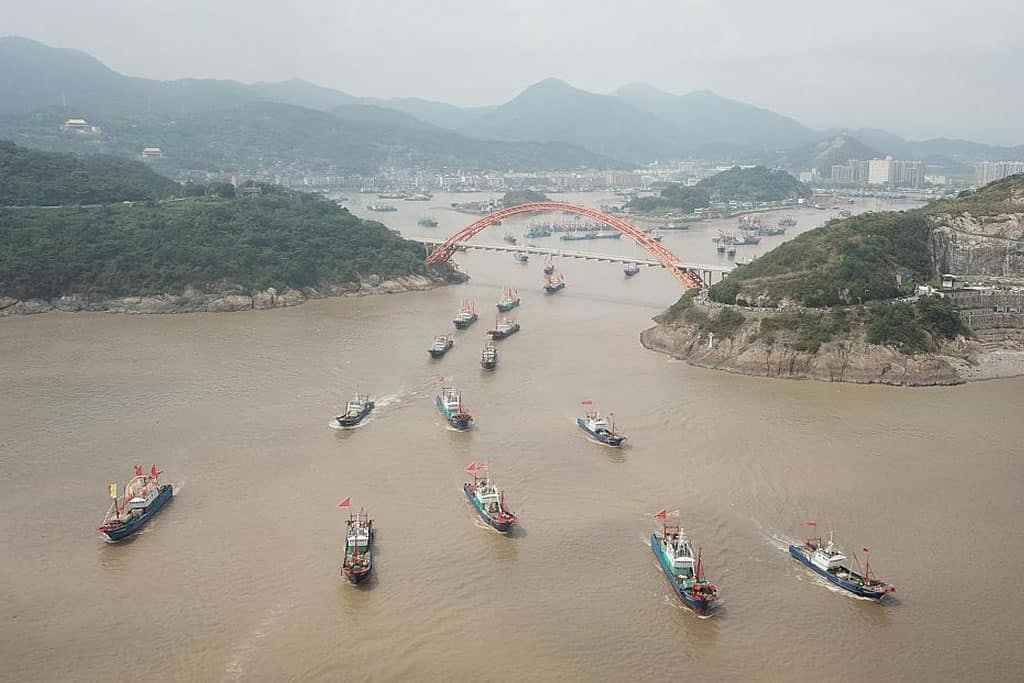
Chinese fishing boats, between food security and geopolitics
Last updated on March 10th, 2023 at 11:25 am
The month of July was about to end when the Ecuadorian naval authorities identified a fleet of 340 Chinese fishing boats near the Galapagos archipelago, a real army that proceeded with the fishing activities to the maximum allowed in an area protected. Today these vessels are still present in the region and have reignited the debate on the practice of overfishing – the overexploitation of fish resources in a given area by the Chinese industry. Activists and environmental protection bodies were very outraged by the massive presence of industrial fishing vessels that threaten the ecosystem with the killing of excessive quantities of fish and shellfish, as well as leaving behind a mass of waste that surfaces on the beaches and in the local fishing nets. The Galapagos case is not isolated.
At the beginning of September, the Pakistan Fisherfolk Forum (PFF) fishing lobby denounced the arrival of about twenty Chinese fishing vessels in the Exclusive Economic Zones (EEZs) of the provinces of Sindh and Baluchistan. The group indicated how intensive fishing has reduced fish stocks by 72% compared to last year. Similar cases have been repeated over the last decade in the waters around Timor Leste, the Philippines, New Zealand. All solved with little fact, if not the complaint and reporting of the companies involved, which got away with the amount of a late payment or removal from the affected areas to return later with altered identifiers and logbooks to preventrecognition.
China is not the only nation to monopolize fishing in international waters, even if the number of hegemonic states in the sector is incredibly low: six. According to research published in Science Advances, China, Taiwan, Japan, Spain, Indonesia, and South Korea hold about 80% of the vessels for international fishing on the high seas. These data reveal a rapidly growing trend, consistent with the growing purchasing power of Asian citizens. An Asia Research and Engagement (ARE) report on protein consumption in Asia predicted a 78% growth in meat and fish purchases by 2050.
Among these, China is the country of concern. Its demographic weight and ample political and economic resources allow Chinese companies to maintain a significant presence in the fisheries sector in international waters. That is counting a fleet of at least 3,000 industrial fishing boats, according to the limits imposed by the thirteenth five-year plan, the biggest in the world. The measures taken by the Chinese government to limit the damage to the image due to multiple international complaints are claims that circumvent the problem. An example is the recent seasonal ban on squid fishing in certain waters between the Pacific and South Atlantic. The restrictions define periods and areas where neither China nor other countries fish for squid because useless: “It is as if China has put a fishing ban on the moon,” the activists replied on Twitter. The lack of effective international measures to counter these activities, coupled with the political instability of most of the countries involved, makes it difficult to counter a phenomenon that will only grow in the coming decades and risks putting Asian and South American nations into one against the others.
In its annual analysis of the state of the People’s Liberation Army (PLA), the Pentagon highlighted the rapid development of China military technologies in the aviation and navy fields, also paying attention to the phenomenon of the militarization of Chinese industrial fishing boats. Civilian involvement in the South China Sea takes place through the Chinese practice of advancing a militarized fleet on state-owned civilian ships. The People’s Armed Forces Maritime Militia (PAFMM) is a civilian reserve coalition that routinely operates by chartering civilian boats. A factor that makes the nature of some industrial expeditions off the coast of China and is highly strategic points in the chessboard of the Sea increasingly ambiguous. South Chinese and the Pacific. The presence of well-equipped ships and exploratory missions, in particular for detecting submarine oil and gas fields, also reinforced the suspicions around the atolls and small islands historically contested by the Chinese government.
Also Read:- China uses Simulation Video Attack to wade off American Interference in Taiwan